
The Truth About NIL
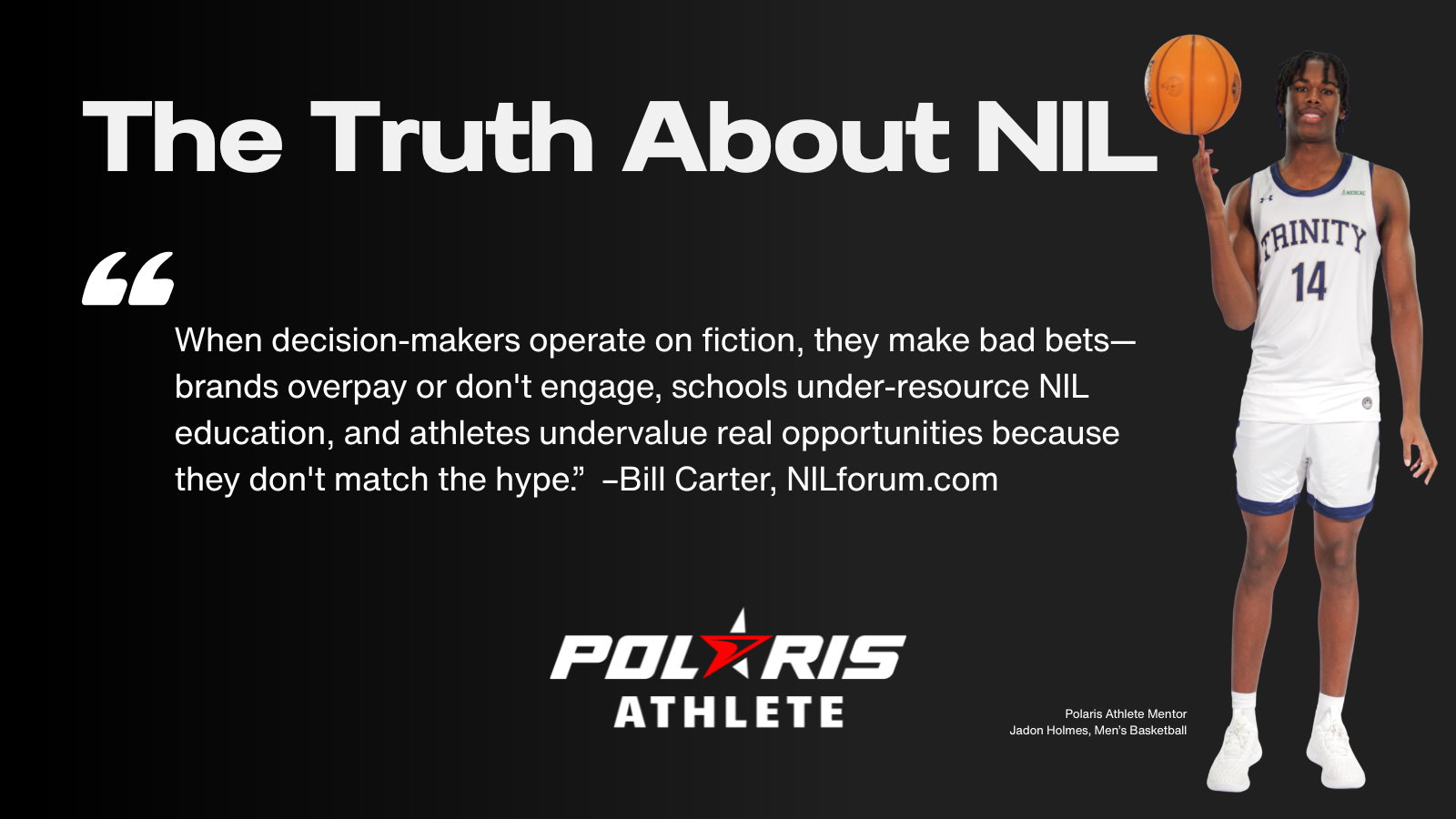
Polaris Athlete Mentor, Jadon Holmes
It's been a while since I sat down to write a blog post. In fact it's been about three weeks but it's been an exciting three weeks coming off presentations at MACAC, SACAC, and WACAC's Northern California Share, Learn and Connect. I’ve had so many incredible conversations and couldn’t be more excited for all that is to come.
With upcoming travel for TACAC, RMACAC, and a College Counseling Roundtable at Swarthmore College, I'm excited to continue sharing the truth about NIL and how us counselors can meet this moment for our student-athletes and their families.
A conversation today reminded me that we need to start at the beginning. We need to begin with the truth about NIL.
This work is personal. It always has been. As a first-generation college graduate, former student-athlete, school counselor, and founding Director of College Counseling, I feel the weight of this moment in regards to NIL education, recruiting literacy, and college counseling.
I spend my days in conversations with student-athletes, families, and counselors who are all trying to make sense of something that feels important, but not always clear.
NIL has quickly become part of the college conversation. Not alongside it. Not after it. Directly within it. And yet, most people are still trying to understand what it actually means.
What the Data Actually Tells Us
There is a narrative around NIL that suggests disruption, distraction, and division.
That is not what student-athletes are telling us.
Bill Carter’s NIL Research Poll, which continues to survey thousands of athletes across the country, offers a much clearer picture.
Only 8% of athletes report locker room tension tied to NIL.
At the same time:
76% of athletes share NIL earnings with teammates
78% have been asked by teammates for advice or guidance
To me, that signals a community trying to learn in real time.
Since October ‘25, we’ve been building our mentorship program. I’ve had hundreds of conversations with collegiate student-athletes across all divisions of college athletics. All of which highlighted the gaps they experienced in high school. Gaps in college advising, recruiting guidance, and NIL education.
Student-athletes are not being pulled apart by NIL. They are trying to figure it out together. In fact, when I share our tool, Polaris Athlete Hub with our mentors, they all claim that they wish they had it in high school.
The Reality Most People Miss
We tend to focus on the visible outcomes. The deals. The numbers. The headlines. But that is not where most student-athletes are living. Keep in mind, the median NIL deal is $60, according to recent NIL data shared by Bill.
Even at that level, the structural gaps are significant:
87% had no financial plan before signing their first deal
78% had nobody prepare them for receiving income as an independent contractor
64% do not understand quarterly estimated taxes
Student-athletes are not being overwhelmed by NIL opportunity. They are entering it without the tools to navigate it and as a result, the questions they are asking are not just about deals.
They are foundational:
What is NIL really?
How does this impact my college decision?
Should this factor into where I go?
Am I making the right choices for my future?
The shift in the recruitment process is real. Families are feeling it. Student-athletes are feeling it. Counselors are feeling it.
The new landscape of athletic recruiting and NIL is not just about opportunity. It is about decision-making in environments that are new, complex, and often unstructured.
NIL and College Access
This is where I believe we need to spend more time as educators. NIL is becoming part of how student-athletes think about college access. Those of us who meet this moment will set our students on a launching pad for their careers.
It shows up in questions around:
Affordability and cost of attendance
Fit and opportunity across programs
Visibility and long-term positioning
The data makes something else clear:
72% of athletes arrive at college with no formal financial education
69% say their high school never discussed financial preparation at all
This is not just an NIL issue. It is a pipeline issue. For some families, NIL can help offset costs or expand what feels possible. For others, it introduces new variables that can complicate an already complex process. The system assumes a level of understanding that not every student-athlete or family has access to. And when that gap exists, it can influence decisions in ways that are not always aligned with long-term outcomes.
NIL and Career Readiness
There is a part of NIL that does not get enough attention and in my opinion it is the part that matters most. NIL is often a student-athlete’s first exposure to real-world decision-making at scale.
From a data standpoint:
38% say their first instinct is to spend NIL income
Only 8% think about taxes first
44% have avoided asking financial questions out of embarrassment
They are learning:
How to communicate in professional settings
How to evaluate opportunities and partnerships
How to manage money and expectations
How to represent themselves and their values
These are not transactional skills. They are foundational. And as college counselors we recognize this as career readiness in real time. When it’s supported correctly, NIL becomes a bridge. Not just to opportunity, but to life after sport.
Why We Are Building Polaris Athlete Hub
Polaris Athlete has always been grounded in one belief: student-athletes and their families deserve clarity as they navigate this process. Not just access to information, but understanding and our platform Polaris Athlete Hub is a continuation of that belief.
We are building it to bring together:
College counseling
NIL education
Career readiness
Recruiting literacy
Because these are no longer separate conversations. They are happening simultaneously, often without alignment and when those pieces are disconnected, student-athletes are left to fill in the gaps on their own.
Looking Ahead
As I continue these conversations across the country, one thing is clear. This moment is not slowing down, and neither can we.
NIL is not a trend we wait out. It is a shift we meet. For counselors, educators, and those of us who sit closest to students and families, the responsibility is in front of us. We have an opportunity to bring clarity where there is confusion, structure where there is uncertainty, and purpose where there is pressure.
When we meet this moment with intention, NIL becomes more than a series of transactions. It becomes a tool for expanding college access, strengthening decision-making, and building career readiness long before graduation. That is the work ahead. And that is the work we are committed to at Polaris Athlete Hub.
Data Source & Methodology
Data referenced in this article is drawn from the NIL Research Poll conducted by Student-Athlete Insights, a monthly survey of 5,000+ college student-athletes and 1,000 high school prospects across NCAA Divisions I, II, and III. The study uses stratified sampling to ensure broad representation across sports and levels of competition, with continuous monthly tracking and full participant privacy protection.
Learn more: https://studentathleteinsights.com/nil-research-poll